The whispering vault under Palazzo del Podestà
Two people, two opposite corners, one column to whisper into. Under Palazzo del Podestà your voice travels right across the vault. Here’s how to try it, and what to look at while you’re there.
If, in the centre of Bologna, you spot two people standing in opposite corners of a covered crossroads, faces pressed to a column like children counting at hide-and-seek, don’t worry. They aren’t unwell and they haven’t been sent to stand in the corner. They’re on the phone. Without a phone.
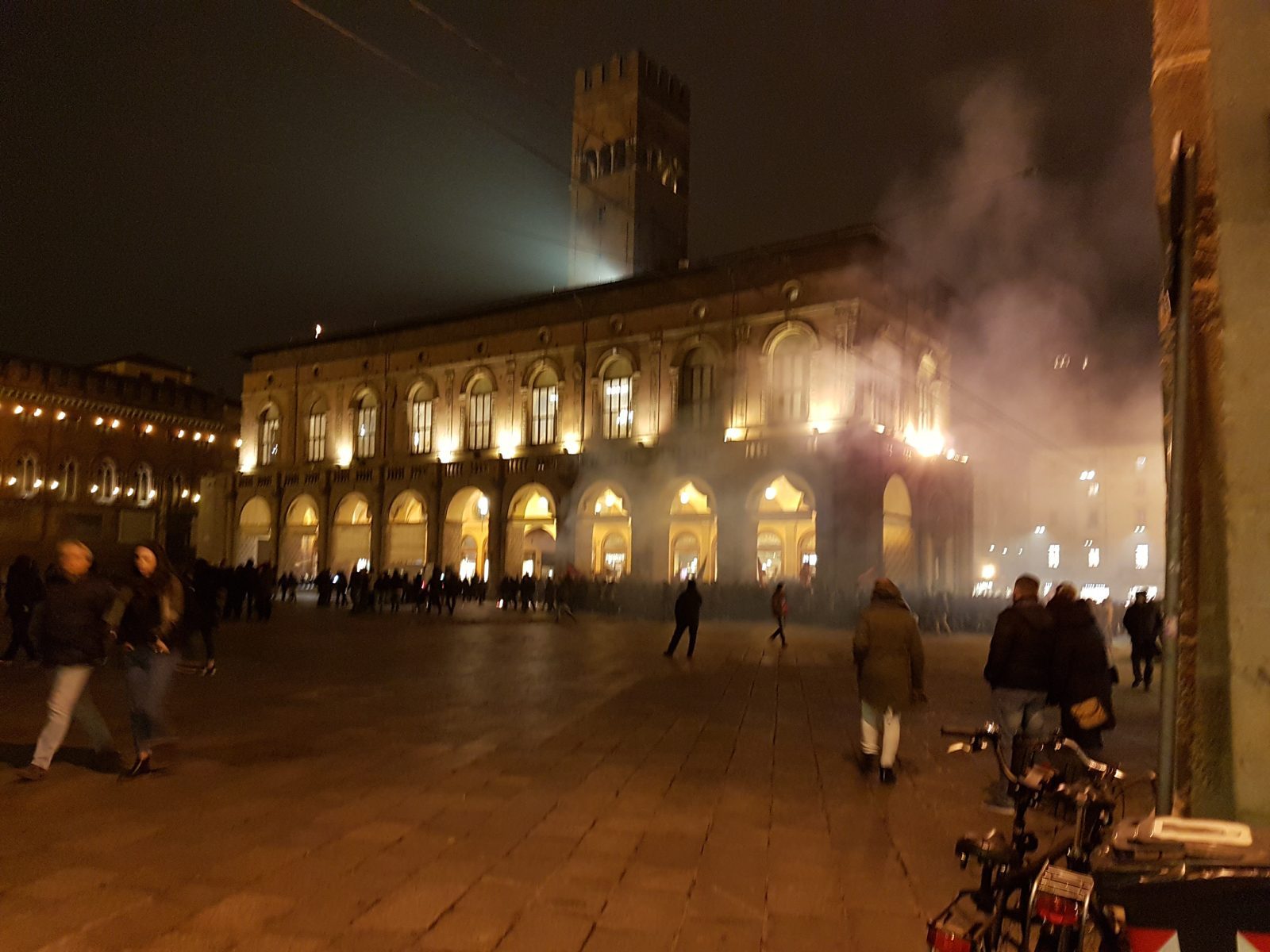
We’re under the Voltone del Podestà, the great vaulted passage between Piazza Maggiore and Piazza del Nettuno. The Bolognese call this trick the telefono senza fili, the “wireless telephone”. In our three secrets of Bologna we gave it just a few lines. It deserves more.
How it works
You need two people. Each picks a corner of the Voltone, diagonally opposite the other, and stands facing the column. Then you speak softly, barely a whisper, into the stone. On the other side, several metres away and with people walking between you, the voice comes through clearly, as if your friend were standing right beside you.
The secret is in the architecture. Large ribs rise from the four corners and meet at the centre of the vault. Instead of scattering into the air, the voice follows the curved surfaces and slides across to the opposite corner. Physicists call it a “whispering gallery”: with the right shape, it happens under other vaults and domes too. But this one is ours, and it’s free.
Confessions at a distance
Every self-respecting Bolognese secret comes with a legend, and this one is no exception. The story goes that the vault was used to hear the confessions of lepers: the sick person in one corner, the priest in the other, and a safe distance guaranteed by physics. A lovely tale. Whether it’s true, though, nobody knows: even Bologna Welcome, the city’s tourist office, admits as much. So we tell it for what it is, a legend.
A crossroads eight hundred years old
The building above your head is Palazzo del Podestà, built at the start of the 13th century as the first seat of the city government. This is where the podestà, the chief magistrate, worked alongside the commune’s judges and notaries. At street level two roads cross and pass beneath the building: that’s the Voltone. Next door, in the mid-13th century, came Palazzo Re Enzo, and today the two form a single complex.
It hasn’t always been a place for whispers. Under these vaults there was a market, with its comings and goings of sellers and buyers, and there were the notaries’ desks. Blasphemers were put in the pillory here for everyone to see, and death sentences by hanging were carried out here too. So much for whispering.
Upstairs is the Salone del Podestà, which over the centuries has been a courtroom, a public theatre and even a ball court. The façade you see from the square was rebuilt in the Renaissance: look at the ground floor, covered in tiles decorated with floral motifs. They say no two are alike. Counting them is up to you.
The four saints
While you wait for your friend in the other corner to stop laughing, look up. Four statues are watching you from the Voltone: they are Bologna’s patron saints, Petronius, Proculus, Dominic and Francis. They are made of terracotta and were modelled in the 16th century by Alfonso Lombardi, a sculptor who left quite a few works around the city. They have overheard centuries of secrets. They have never told a single one.
The big bell
Higher still, above the Voltone, rises the Torre dell’Arengo. In the early 13th century it was little more than a raised section over the crossroads; it only became a tower later, after reinforcement work. It has never been a model of solidity: shallow foundations, thin walls at the base. And yet it has stood for centuries, resting on the very arches you are whispering under. Best not to think about it too much.
At the top hangs the campanone, nicknamed the campanazzo, “the big old bell”: 4,700 kilos of bronze, hoisted up there in 1453 by Aristotele Fioravanti. For centuries it called the people of Bologna together. On 21 April 1945 it rang for the city’s liberation, and every year on 21 April it rings again to remember it. Under the same tower, then, live Bologna’s loudest voice and its quietest.
How to try it. Go in a pair, take the diagonally opposite corners and speak softly, with your mouth close to the column. It’s easier with less noise around, early in the morning or in the evening. The Voltone is a thoroughfare, so leave room for people walking through. And if someone in the opposite corner is already whispering something to you, as they say in dialect, it pays to stèr in uràccia: to stay on your toes.
Take a piece of this story home
Bologna travel guide
An up-to-date guide for first-timers and for those hunting hidden details.
View on Amazon
See our suggestions As an Amazon Associate, Socmel! earns from qualifying purchases.