Laura Bassi, the professor who taught in her living room
In 1732, aged twenty, she defended her theses in front of half of Bologna. The university made her a professor but kept her out of the lecture halls. So she opened a laboratory at home.
Near the Giardini Margherita park there is a street called Via Laura Bassi Veratti. Plenty of Bolognese walk down it every day without wondering who the lady on the sign was. Let us introduce her: she is the woman who, in the eighteenth century, persuaded the oldest university in the Western world to let her teach. Sort of.
A girl who studied too much
Laura Bassi was born in Bologna in 1711, the only daughter of the lawyer Giuseppe Bassi. Her first lessons came from a relative who was a priest, Lorenzo Stegani. Then the family doctor, Gaetano Tacconi, took over. He taught at the university, and he soon realised his pupil was out of the ordinary.
In 1731 Tacconi arranged a kind of private exam: some of the city’s scholars came to question the young woman, along with the cardinal archbishop Prospero Lambertini, the future Pope Benedict XIV. Lambertini was impressed, and from then on he was her great protector.
1732, the year of wonders
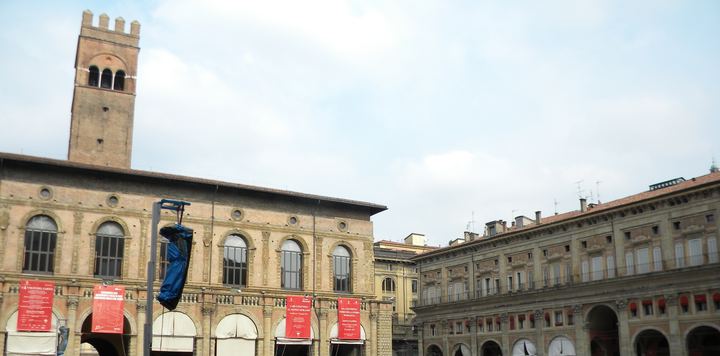
What happened next, the University of Bologna calls its annus mirabilis. In March Laura joined the Academy of Sciences, its first female member. On 17 April she publicly defended 49 philosophy theses against the professors of the university, in the Palazzo Pubblico, today’s Palazzo d’Accursio, the city hall. A few weeks later, in May, came her degree in philosophy. She was twenty.
And there was more. In June she defended further theses to earn the right to teach, in the autumn she was given a post in natural philosophy, and in December she gave her first lecture.
A professor, up to a point
There was a catch, though. Laura could only teach on special occasions, the formal public lectures. Ordinary classes, made up entirely of young men, stayed closed to her. She was a professor to be shown off rather than listened to.
In 1738 she married Giuseppe Veratti, a physician and also a physics professor. They had eight children, five of whom reached adulthood. Meanwhile Laura asked for more teaching hours. The answer was no.
The laboratory in the living room
So if the students could not come to her at the university, they came to her at home. From 1749 the Bassi Veratti couple ran regular courses in experimental physics in their house, with a laboratory of their own. Laura was a committed follower of Newton, and her lessons brought the new physics to Bologna, built on experiments rather than words. With her husband she also studied the medical uses of electricity.
The living room turned into a small scientific hub. Among the pupils was a young relative of hers, Lazzaro Spallanzani, who would become one of the great biologists of the century. Alessandro Volta visited too. Voltaire wrote to her admiringly. The city Senate, impressed, raised her pay several times: anything rather than really let her into the lecture halls.
Her old friend Lambertini, now pope, did his bit as well. In 1745 he created a select group of scholars within the Academy, the Benedettini, and Laura was admitted. But as an extra member, without a vote: that way no male colleague lost his seat. The world was changing, but slowly.
A chair at last
Her moment came late. In 1776, by then in her sixties, Laura Bassi was given the chair of experimental physics at the Istituto delle Scienze, Bologna’s Institute of Sciences. She was the first woman in the world to hold a university chair in physics. Her official assistant? Her husband. We like to imagine the family dinners.
She did not enjoy it for long: she died in Bologna on 20 February 1778. She is buried in the church of Corpus Domini, where Luigi Galvani, the man of the frogs and “animal electricity”, also lies.
Why remember her
Laura Bassi did not change the rules of her time single-handedly. She bent them, patiently, until they made room for her. Today a street and several schools in Bologna bear her name, and in 2021 Google gave her its doodle on 17 April, the anniversary of her 49 theses. Not bad for someone who was only supposed to lecture on holidays.
Following in her footsteps. Start in Piazza Maggiore: it was in Palazzo d’Accursio that Laura defended her theses. Then stroll to the Giardini Margherita to say hello to her street.